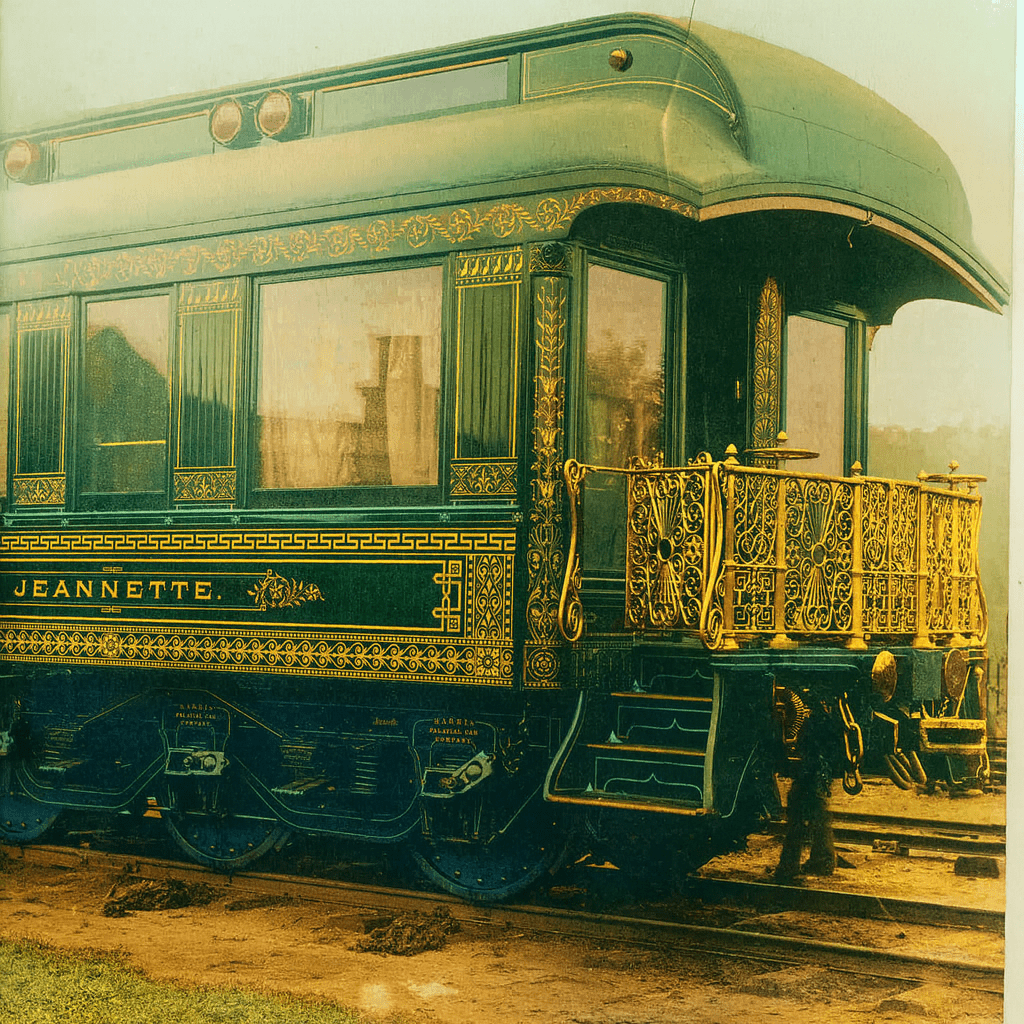
Somehow I manage to find the most unique railroad equipment to model, and the Harris Palatial Car Company combine/parlor/sleeper Jeannette does not get any better than that—oh, what a find! And usually, as luck would have it, information about the passenger carriage is not easily or readily found. In this case, tidbits of information happened to be located all over the place, making it difficult to write a useful paper without a lot of work.
Not only does the word “palatial” describe what was ahead of its time in transport luxury, but two factors stopped me in my tracks, making me know I had to learn more. Factor number 1 was learning that a 3/4″ scale model was produced before the car went into manufacturing. I’m not sure if that was common for the times or if the Harris Company was innovating to get ahead of the competition, which would have been Pullman. Factor number 2: a palace, as would be expected, was not only a gem on the outside, but the craftsmanship inside and its furnishings were second to none. And to accommodate this, the internal architecture, as described, indicated that sleeping berths were somehow built into or below floor level. It’s hard to imagine, knowing that construction of those period cars were mostly wood and cast iron, not steel with long tie rods, but those ideas were probably why Harris was awarded patents.
It does seem odd that those patents were obtained in Canada. The likely reason being that it was cheaper and quicker than the application process at the US Patent Office, and a patent would give some legitimacy to a young company.
The research is far from complete, and thus I am asking for any volunteers who might want to contribute to the analysis and organization of the facts gathered so far. Or, if anyone knows of other resources—photographs, negatives, or old postcards that might yield more information about the history of this car—please reach out. Below are the links to the 1st Draft of researched information in PDF format and two PDF files that is the analysis done by Claude. There are many open questions or theories, timelines, and events whereby another set of eyes and sharp thinking could develop a pretty good record about this unique car called Jeannette. The technology is also requiring more analysis because it might surprise modern-day modelers that this car ran on paper wheels. One must remember that in the 1800s, one would not have found a totally vertically integrated factory. Thus, given the location—from Boston to Maine—many trades and specialty craftsmen would have been contributing to the construction of the car. And, because of the Panic of 1893, the economy was in rough shape, which may have delayed construction. So I also find the people involved at the time to be as interesting as the car itself.
Feel free to comment on the YouTube video or email me (jwubbel@allnationline.com) for further discussions.
Review the PDF “1st DRAFT Research Data On Jeannette” – Click Here
Review the PDF “Jeannette Analysis” – Click Here
Review the PDF “Denham Model Maker Theory” – Click Here